

Airbnb Maintenance in Arizona: Costs, Checklist and Remote-Host Emergencies (2026)
Estimated reading time: 10 minutes
Last updated: October 18, 2026. Now includes how Airbnb maintenance management works, a repair triage guide and what to put in a maintenance contract.
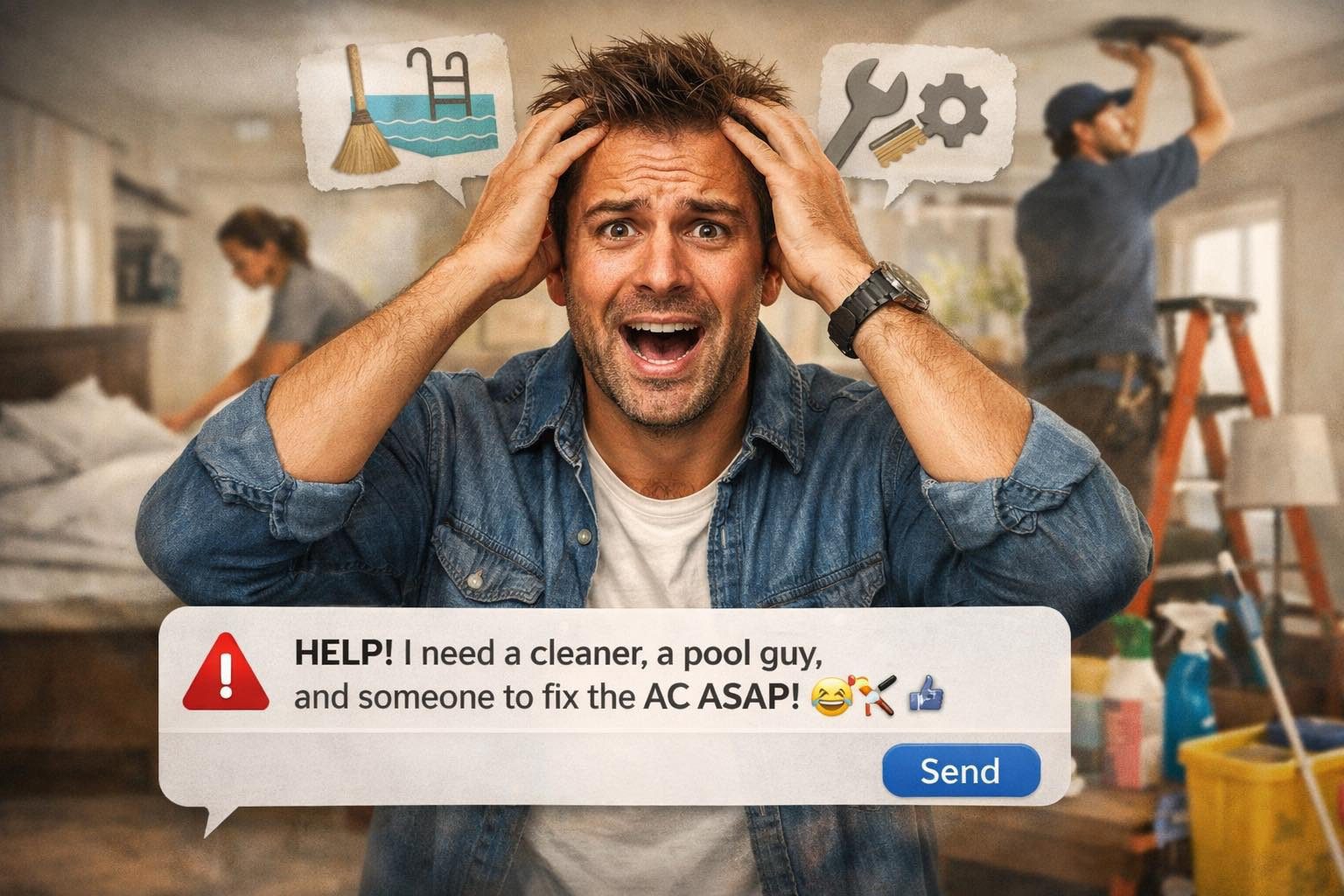
Managing a short-term rental remotely sounds simple—until something small goes wrong.
And in this business, it’s rarely the big, obvious issues that hurt you.
It’s the small, overlooked maintenance problems that turn great stays into bad reviews.
If you’re running an Airbnb or vacation rental from out of state, here’s what most hosts don’t think about—and why it matters.
Airbnb Maintenance at a Glance
Airbnb maintenance is the preventive upkeep, turnover inspections and on-call repairs that keep a short-term rental guest-ready between stays. For an Arizona Airbnb, it comes down to four things:
- Budget: set aside roughly 1%–3% of the home’s value per year, or 10%–15% of rental revenue.
- Biggest risks: air conditioning in summer heat, pool and spa equipment, water heaters and plumbing, and pests.
- Prevention: a checklist at every turnover plus a monthly, quarterly and seasonal service calendar.
- Emergencies: a local 24/7 vendor bench and a clear escalation plan, because remote hosts can’t respond in person.
This guide is written by Travli Hospitality Co., a Scottsdale, Arizona vacation rental and Airbnb property management company that maintains 100+ short-term rentals across Scottsdale, Paradise Valley, Phoenix and Sedona with in-house maintenance, cleaning and pool teams.
The Small Problems That Turn Into Big Reviews
Smoke Detector Chirping at 2AM
A dead battery isn’t a big deal—unless the detector is mounted 12–15 feet high with no ladder available.
Your guest can’t fix it.
They can’t sleep.
And now you’ve got a preventable complaint.
Tripped Breakers Guests Won’t Touch
Power goes out in part of the home.
To an experienced homeowner, it’s a quick reset.
To a guest? It’s intimidating—and often ignored.
Result: frustration, downtime, and messages you can’t solve remotely.
Scorpions, Bugs, and “Arizona Reality”
Even clean, well-maintained homes in Arizona can occasionally see pests.
For guests unfamiliar with the desert, this becomes a major experience issue, not a minor one.
Response time and handling make or break the review.
Pool Equipment Issues on Weekends
Low water → air in the system → pump running dry.
This can escalate into thousands in damage fast—especially in Arizona heat.
And it always seems to happen when vendors aren’t available.
No Hot Water at Night
Pilot light out. Reset tripped. Minor fix.
But at 9PM, with a guest in the shower?
It’s a high-impact problem that feels major to them.
Other Common STR Maintenance Issues Remote Hosts Miss
- Dead smart lock batteries → guest lockouts
- Thermostat or WiFi outages → uncomfortable stays
- Running toilets → wasted water + noise complaints
- Missed trash service → neighbor issues
- Minor cleaning misses → immediate guest complaints
- Ants or insects after guest turnover
- Landscaping neglect → poor first impressions
Individually small.
Operationally critical.
How Airbnb Property Maintenance Management Works
Professional Airbnb property maintenance management isn’t one service. It’s a system with four layers, and remote hosts get into trouble when any one of them is missing:
- Turnover inspections: the cleaning team checks locks, Wi-Fi, thermostat, water pressure, detectors and the pool at every checkout and reports issues with photos before the next guest arrives.
- Preventive maintenance: a fixed calendar of HVAC filters and service, water-heater flushes, pest treatment, pool equipment checks and seasonal Arizona prep, so failures are caught before they happen.
- Reactive and emergency repairs: a dispatcher who triages guest messages and sends a vetted technician the same day, day or night.
- Tracking and owner reporting: every work order is logged with cost, photos and the vendor used, so owners see where money goes and which equipment is near the end of its life.
An Airbnb maintenance service or full-service vacation rental management company should handle all four layers. A handyman alone usually covers only reactive repairs, which is why remote hosts who rely on one person tend to see the same problems repeat.
A Preventive Airbnb Maintenance Schedule
The cheapest repair is the one you prevent. Remote hosts who run on a fixed maintenance calendar—rather than reacting to guest complaints—protect both their reviews and their margins. Use the schedule below as a baseline for any Arizona short-term rental.
| Frequency | Maintenance Tasks |
| Every turnover | Test smart locks, Wi-Fi and thermostat; run all faucets and flush toilets; confirm AC and heat cycles; restock and test smoke & CO detectors; quick pool and exterior walk-through. |
| Monthly | Replace HVAC filters; check under-sink and water-heater areas for leaks; test detector batteries; treat for ants and scorpions; verify pool chemistry and equipment. |
| Quarterly | Service the HVAC system; flush the water heater; re-caulk tubs and showers; inspect roof, exterior and irrigation; deep-service pool equipment. |
| Seasonal (Arizona) | Full AC service before summer 110°F-plus heat; pre-monsoon roof and drainage check; scorpion and pest treatment; landscape and irrigation reset for winter. |
What Airbnb Maintenance Costs in Arizona
Most owners should set aside roughly 1% to 3% of the property’s value each year, or about 10% to 15% of rental revenue, for maintenance and repairs. Short-term rentals wear much faster than long-term rentals because guests turn over every few days, and Arizona adds two big cost drivers: air conditioning that runs almost nonstop from May to September, and pool equipment working hard in extreme heat. Owners who keep a dedicated reserve and pay for preventive service almost always spend less over time than owners who wait for things to break.
What Breaks Most Often in Arizona Vacation Rentals
- Air conditioning and HVAC: the number-one emergency in Arizona rentals, and it always seems to fail during a heat wave.
- Pool and spa equipment: pumps, heaters and salt cells work overtime, and water chemistry can turn a pool green between guests.
- Water heaters and plumbing: hard water shortens equipment life and causes buildup and leaks.
- Pests: scorpions, roof rats and ants are common and can sink a review instantly.
- Landscaping and irrigation: drip systems clog, and even desert landscaping needs regular attention.
- Appliances and smart devices: heavy guest use wears out refrigerators, dishwashers, locks and thermostats quickly.
Airbnb Property Repairs: Fix Now or Fix Between Stays?
Not every Airbnb property repair needs a 2 a.m. call-out. Triage protects both the guest experience and your budget:
- Fix immediately (same day): no AC or heat in extreme weather, active water leaks, no hot water, power loss, gas smell, broken locks or lockouts, anything that affects safety.
- Fix within 24–48 hours: a broken appliance, a pool that is unusable, a Wi-Fi outage, a toilet that won’t stop running, pest activity.
- Fix at the next turnover: cosmetic damage, a loose cabinet door, a burned-out bulb in a non-essential room, touch-up paint.
- Plan and budget: aging AC units, water heaters and pool pumps showing wear. Replace them before peak season rather than during it.
Document every repair with photos and keep receipts. Guest-caused damage can often be claimed through Airbnb’s host damage protection, but only with clear before-and-after evidence and a quick report.
Handyman, Home Warranty or Management Company?
- On-call handyman: flexible and fine for one property, but hard to book in peak season when every owner needs help at once.
- Home warranty: can offset big-ticket repairs, but approvals and approved-contractor delays rarely fit a same-day rental emergency.
- Full-service management with in-house crews: the fastest and most consistent option, because the team already knows the home and controls the schedule. This is why we built our own teams, explained in how our in-house vendor network works.
Airbnb Host Maintenance Contracts: What to Put in Writing
If you hire a maintenance vendor or a management company, a written Airbnb maintenance contract prevents most disputes. Make sure it covers:
- Response times: how fast they respond to emergencies versus routine requests, including nights, weekends and holidays.
- Approval limit: the dollar amount they can spend without asking you first, so urgent repairs aren’t delayed.
- Scope: what’s included (inspections, filters, pest control, pool) and what’s billed separately.
- Pricing: hourly rates, trip fees, after-hours premiums and parts markup.
- Licensing and insurance: proof of liability insurance and the right trade licenses for HVAC, electrical and plumbing work.
- Reporting: photos, invoices and a work-order log for every visit.
With full-service management, these terms sit inside the management agreement, so you deal with one contract and one point of contact rather than a separate vendor for every trade.
Handling Emergency Maintenance When You Are Not There
In Arizona, some failures are true emergencies: no air conditioning in summer, no hot water, an active water leak, a tripped breaker that kills half the house, or a guest lockout. A remote host needs a response system in place before the 11 p.m. message arrives.
- A 24/7 vetted vendor bench—HVAC, plumbing, electrical, pool and locksmith contacts who already know your property and will take an emergency call.
- Guest-facing instructions in the listing—breaker-panel location, thermostat guide, Wi-Fi router reset and who to contact, so minor issues are solved in minutes.
- A clear escalation path—what the guest can fix, what triggers a same-day vendor visit, and when to offer a partial refund or relocation.
Can an Airbnb host cancel a reservation over a maintenance issue? Yes—Airbnb allows cancellations for genuine, safety-related problems under its disruptive-event policies, but frequent cancellations carry penalties and can cost you Superhost status. Fixing the issue fast, or relocating the guest to a comparable home, almost always protects your standing better than canceling.
Airbnb Maintenance FAQ
Who handles maintenance for an Airbnb?
Owners generally choose one of three models: do it themselves, keep an on-call handyman with pool and HVAC contractors, or hand it to a full-service manager with an in-house maintenance team. Remote hosts almost always need the second or third option, because same-day response is impossible from out of state.
How much should I budget for Airbnb maintenance?
A common rule of thumb is roughly 1% to 3% of the property value per year, or 10–15% of rental revenue, set aside for repairs and upkeep. Arizona homes should budget toward the higher end, because pools, air conditioning under extreme heat and pest control all add recurring cost.
What does an Airbnb maintenance service include?
A complete Airbnb maintenance service includes turnover inspections, a preventive maintenance calendar (HVAC, plumbing, pest control and pool), 24/7 emergency dispatch, vetted local technicians, and a work-order log with photos and costs for the owner.
Do I need a maintenance contract for my Airbnb?
Yes, if anyone other than you handles repairs. A written contract should set response times, a spending approval limit, scope, pricing, insurance requirements and reporting, so emergencies are handled without back-and-forth.
How often should an Arizona Airbnb’s AC be serviced?
At least twice a year, with a full service in spring before summer heat, plus a filter change every month. Short-term rentals run their AC harder than typical homes because guests rarely adjust thermostats to save energy.
How do remote hosts handle emergency repairs?
With a local, pre-vetted vendor network on 24/7 call, clear guest instructions for the common quick fixes, and a coordinator who can dispatch a technician the same day. Without local infrastructure, a single AC failure in July can turn into a one-star review and a refund.
What is the most common Airbnb maintenance issue in Arizona?
Air-conditioning failures during extreme summer heat, followed by pool-equipment problems and pest intrusions. All three are predictable, which is exactly why a preventive schedule and a local vendor bench pay for themselves.
Why Remote Airbnb Hosting Fails Without Local Support
Short-term rentals are not passive investments—especially from a distance.
They require:
- Fast response times
- Preventative maintenance
- Local vendor coordination
- Consistent quality control
Without a reliable system in place, small issues compound quickly into:
- Lower reviews
- Refund requests
- Reduced occupancy
- Long-term revenue loss
The Solution: FIXT Home Services
If full-service property management isn’t your goal, you still need local infrastructure.
FIXT Home Services is built specifically for short-term rental owners who want professional-level maintenance without full management.
If you would rather hand off everything, Travli manages short-term rentals end-to-end across Phoenix, Scottsdale, Paradise Valley, and Sedona.
What You Get:
- On-demand repairs with fast response times
- Preventative maintenance to avoid guest issues
- STR-experienced technicians who understand urgency
- Monthly subscription or flexible service options
- A single, reliable network—no vendor hunting
This is the difference between reacting to problems and staying ahead of them.
Final Takeaway
Success in short-term rentals isn’t just about pricing, design, or location.
It’s about execution.
And execution comes down to handling the small things—quickly, consistently, and professionally.
If you’re managing remotely, those “small things” are exactly where most hosts fall short.
Want to protect your reviews and your revenue?
FIXT Home Services gives you the boots-on-the-ground support every remote host eventually realizes they need.

Key Takeaways
- Remote Airbnb maintenance often overlooks small issues that can lead to poor guest experiences and bad reviews.
- Common problems include chirping smoke detectors, tripped breakers, pests, and pool equipment failures.
- STRs require fast response times, preventative maintenance, and local vendor coordination to avoid compounding issues.
- FIXT Home Services offers on-demand repairs and experienced technicians to help remote hosts manage maintenance effectively.
- Success in remote hosting depends on consistent, professional execution of even the smallest maintenance tasks.
